Why Retaining Walls Fail: Hydrostatic Pressure
Walls rarely fail from the weight of the soil alone. They fail from water. This is the most useful thing to understand before you hire anyone.
When rain soaks into the ground behind a retaining wall and has no way out, it builds what is called hydrostatic pressure, water pushing sideways against the back of the wall. That force adds to the load of the soil itself and can exceed what the wall was built to hold. So when a wall leans, bulges or slides, the
block is rarely the cause. Trapped water usually is.
Atlanta’s red clay makes this more likely. Clay drains slowly, so water collects behind the wall and stays there. A downspout emptying near the top, or a slope that directs runoff toward the wall, adds to the pressure every time it rains.
That is why much of a well-built wall is never seen: drainage stone behind it, a perforated pipe with a proper outlet, filter fabric to keep the stone from clogging, and geogrid reinforcement where the height
requires it. Together, they relieve the pressure before it can build.
What We Build
Segmental block walls
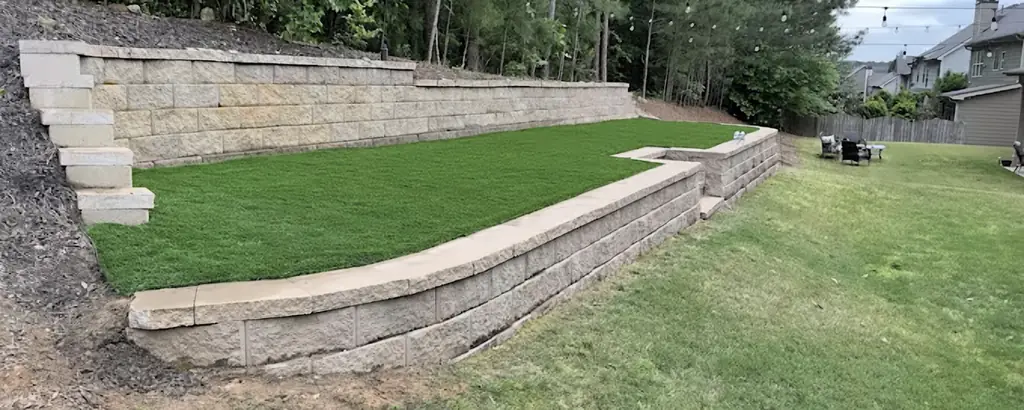
Manufactured concrete units, dry-stacked with a setback batter. The workhorse of residential walls:engineered systems, a wide color range, and they can be reinforced with geogrid for taller sections.
Natural stone walls
Stacked fieldstone or granite. Slower to build and more expensive per foot, and nothing else looks like it once it settles into a planted slope.
Boulder walls
Large stone set with machinery. Fast on the right site, informal in appearance, and often the most
economical option when the boulders can be sourced nearby.
Poured concrete walls
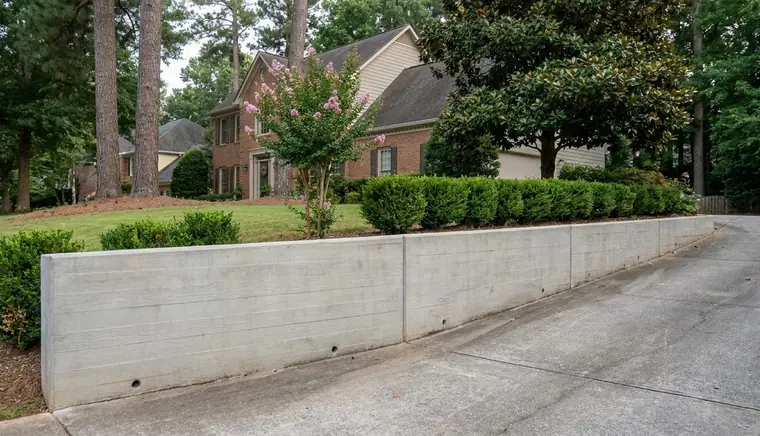
For sites where a rigid, engineered structure is the right answer. Usually faced with veneer afterward.
Seating and garden walls
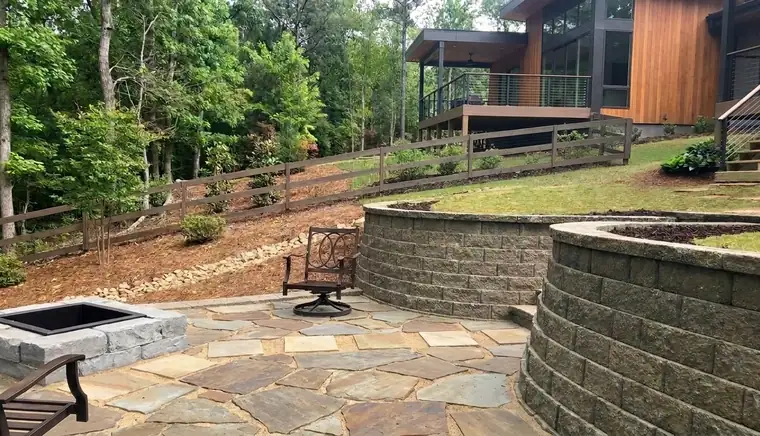
Low walls that terrace a slope or ring a patio. Not structural in the engineering sense, but still needing a proper base if they are going to stay straight.
Timber wall replacement
Landscape timber walls have a lifespan, and in Georgia’s humidity it is shorter than people expect. When they go, we take them out and rebuild in block or stone.
Retaining Wall Repair in Atlanta
Most failing walls show the same early signs. One end starts to lean, a bulge forms in the middle, a joint opens, or the top course tips forward. Sometimes a section has already come down.
Each of these points to movement behind the wall, usually from water pressure or a shifted base. The question is whether it can be repaired or needs rebuilding.
When repair makes sense
Minor settlement in one area, a small section that can be taken down and reset, or a sound wall with a drainage problem that can be corrected from behind or above.
When a rebuild is the better choice
If the wall was built without drainage, a compacted base, or the reinforcement its height required, resetting the block only delays the same failure. We will recommend rebuilding and show you exactly why.
Either way, the first step is finding where the water is coming from. Otherwise you pay for the same problem twice.
Height, Permits and When an Engineer Is Required
The rule most Atlanta homeowners have never heard.
Across metro Atlanta counties, retaining walls above a certain height, commonly four feet measured from the bottom of the footing to the top of the wall, require a permit and an engineered design stamped by a
licensed professional. Some jurisdictions set it lower. A surcharge on top of the wall, like a driveway or a pool, can pull a shorter wall into the same requirement.
The exact rules depend on where the wall is, since each city and county in Metro Atlanta sets its own. Under Fulton County’s retaining wall permit rules, for example, a wall between 4 and 6 feet can be permitted with an owner certification, but anything over 6 feet needs an engineer to sign off.
This matters for three reasons:
For walls that require one, we take care of the application and the engineered drawing that goes with it, working to the engineer’s specification. Where no stamped design is needed, we tell you that up front and
the cost comes off.
What Goes In Behind the Wall
The parts you pay for and never see again.
A compacted base
Excavated below grade, filled with compacted aggregate, leveled. The first course sets the accuracy of every course above it.
Drainage aggregate
Clean, angular stone backfilled behind the wall so water moves down through it instead of sitting in clay against the block.
A drain pipe with an outlet
Perforated pipe at the base, sloped, running to daylight or a drainage system. A pipe that does not go anywhere is decoration.
Filter fabric
Separates the drainage stone from the surrounding soil so fine clay particles do not migrate in and clog it. Skipping this is why some walls drain well for four years and then stop.
Geogrid where required
Layers of high-strength mesh extending back into the hillside, tying the wall to the soil mass behind it. Taller walls need it. It is also the thing most commonly left out of cheap quotes, because it is buried and
nobody checks.
What a Retaining Wall Costs in Atlanta
Retaining walls are priced by the square foot of wall face, but the site usually has as much say in the final number as the wall does.
Material
Block, natural stone, boulders or poured concrete.
Height
Taller walls need geogrid and, above a certain height, a stamped design and permit.
Excavation
How much soil comes out, and whether an old wall has to be removed first.
Drainage
The stone, pipe and outlet that decide how long the wall lasts.
Access
A site machinery can reach costs far less than one worked by hand.
Our quote follows the site visit and lists each of these separately. Most of what you pay for sits behind the wall, where the drainage and reinforcement do their work.
Our Work
See Our Retaining Wall Projects
Block, stone and boulder walls we’ve built across Metro Atlanta.