Where Turf Actually Makes Sense
Turf is not a better lawn. It is a different product, and it solves a specific set of problems very well.
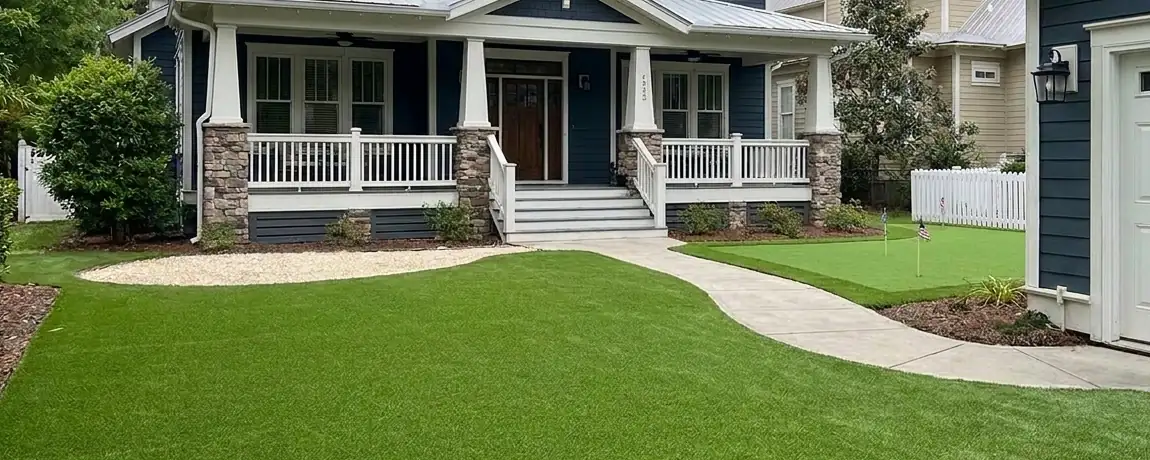
It works in yards where grass has never taken: deep shade under mature hardwoods, a slope that washes out every storm, a side yard the sun never reaches. It works in dog runs, where a real lawn becomes mud by February. It works around pools where sod and chlorine fight each other, and on small courtyards where mowing is more hassle than the lawn is worth.
It works less well as a full front-yard replacement on a large lot, purely because of what it costs at that scale, and in areas that get very heavy sun and are used barefoot in summer.
Half the inquiries we get are for a whole yard. Around half of those end up doing one problem area instead, and being happier for it.
What Goes Under the Turf
This is where installations succeed or fail, and it is more important in Atlanta than in most of the country.
Turf itself drains, since the backing is perforated. But water has to go somewhere after it passes through, and Georgia red clay does not let it through. Put turf straight onto clay and you get a sponge: the base
stays saturated, it holds odor if pets use it, and the surface goes soft and uneven.
So the build matters.
Excavation
Existing grass and topsoil come out, usually three to four inches, sometimes more depending on drainage.
A drainage layer
Crushed aggregate, compacted in lifts, that both supports the surface and gives water somewhere to travel. On heavier clay we add drain lines running to daylight rather than hoping the base copes.
Weed barrier
Between base and turf, so nothing comes up through the seams.
Turf, seamed and anchored
Rolls laid in one direction so the blades face the same way, seams glued rather than sewn, edges anchored with nails or a fixed border so nothing lifts.
Infill
Brushed into the fibers to hold the blades upright and weigh the turf down. This is also where pet-specific systems differ, covered below.
Artificial Turf for Dogs
Dog runs are one of the best uses for artificial turf, and also the easiest to get wrong.
The turf itself is not the problem. Urine drains straight through the backing. The trouble starts underneath:if the base holds moisture, it holds odor too, and by the second summer you can end up with a smell that
hosing down will not fix.
That is why a pet turf installation is built differently from a standard one. It starts with a deeper layer of drainage aggregate, often topped with a permeable base so liquid keeps moving down and away. Instead
of plain sand, the infill is antimicrobial, usually zeolite or a coated alternative that traps ammonia rather than letting it linger. After that, a light rinse on a regular schedule keeps it fresh.
Built this way, a turf dog run stays clean, dry and usable all year. Built cheaply, it is where most odor problems begin.
The Heat Question
Nobody selling turf brings this up, so we will.
Synthetic turf gets hot in direct summer sun, considerably hotter than natural grass, which cools itself by evaporating water. On a July afternoon in Atlanta, turf in full sun can be uncomfortable to walk on barefoot and warm enough that dogs will avoid it in the middle of the day.
What reduces it: shade from existing trees, a pergola or the house; lighter-colored turf and certain infill types; and a rinse, which drops the surface temperature quickly.
What this means practically: turf in a shaded backyard or a side yard is fine year-round. Turf in an open, south-facing lawn used barefoot in summer is worth thinking about before you commit. We would rather say that now than after.
Choosing the Turf Itself
Blade shape, height and density matter more than brand names.
Blade shape
Diamond and W-shaped yarns stand up better under traffic, which is right for play areas and dog runs.Oval and S-shaped blades are softer and look more like a lawn, better for ornamental areas.
Pile height
Shorter piles, roughly three-quarters to one and a quarter inches, handle traffic and clean more easily, and are the usual choice for pets and play. Taller piles look more like real grass but flatten under regular use.
Face weight and density
More yarn per square yard means it stands up longer and looks fuller. It is also most of the price difference between a cheap turf and a good one.
Color
Multi-tone turf with a brown thatch layer reads as real. Single-tone bright green reads as plastic from across the yard, and it is the giveaway on cheap installs.
What Artificial Turf Costs in Atlanta
Turf costs more than sod on the day it goes in. After that, it costs very little. Sod is cheaper to install but then needs water, fertilizer, weed control and regular mowing every year for as long as you have it. For most homeowners, the real comparison is over several years, not on installation day. Small areas that are hard to maintain tend to pay back sooner than large open lawns.
The installed price itself depends on a handful of things. Turf quality is the biggest one: denser, better-built turf costs more and lasts longer. Larger areas usually cost less per square foot than small ones. The site matters too, including how deep the excavation goes, whether drain lines are needed, and how many curves, edges and obstacles the area has. A pet installation adds a deeper base and antimicrobial infill. Easy access for machinery and for hauling away the old sod helps keep costs down.
Every property is different, so pricing is set after we have walked the site and seen what the ground needs.
Turf Is Low Maintenance, Not No Maintenance
Worth being straight about, because the brochures overstate it.
Every few months, brush the blades upright in the areas you actually walk on. Rinse it, more often if dogs use it. Top the infill up occasionally where traffic has pushed it around. Blow the leaves off, same as any
surface, since mature Atlanta hardwoods drop a great deal in November and left sitting it goes slimy.
That is it. No mowing, no watering, no fertilizer, no pollen. Compared to keeping Fescue alive through a Georgia August, it is nothing.
Our Work
See Our Artificial Turf Projects
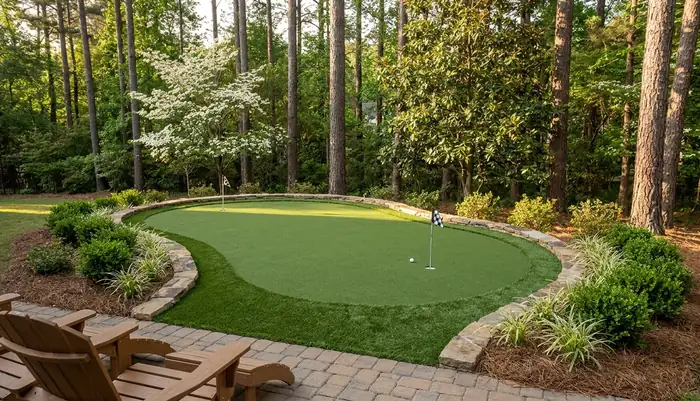
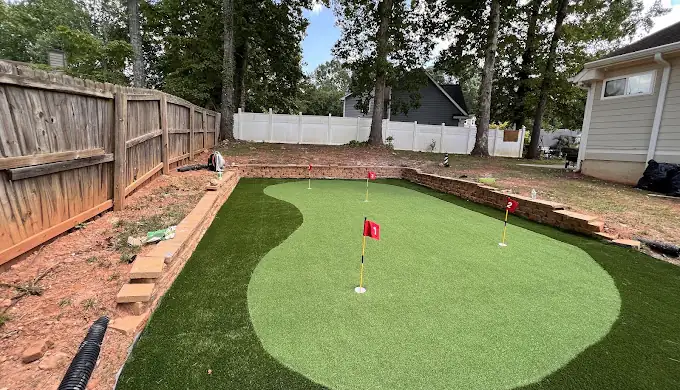
Turf lawns, pet areas and putting greens across Metro Atlanta.
Artificial Turf Questions