Which One You Want Depends on How You Sit
People usually arrive knowing they want fire and not much beyond that. The choice is worth ten minutes because the two do genuinely different things.
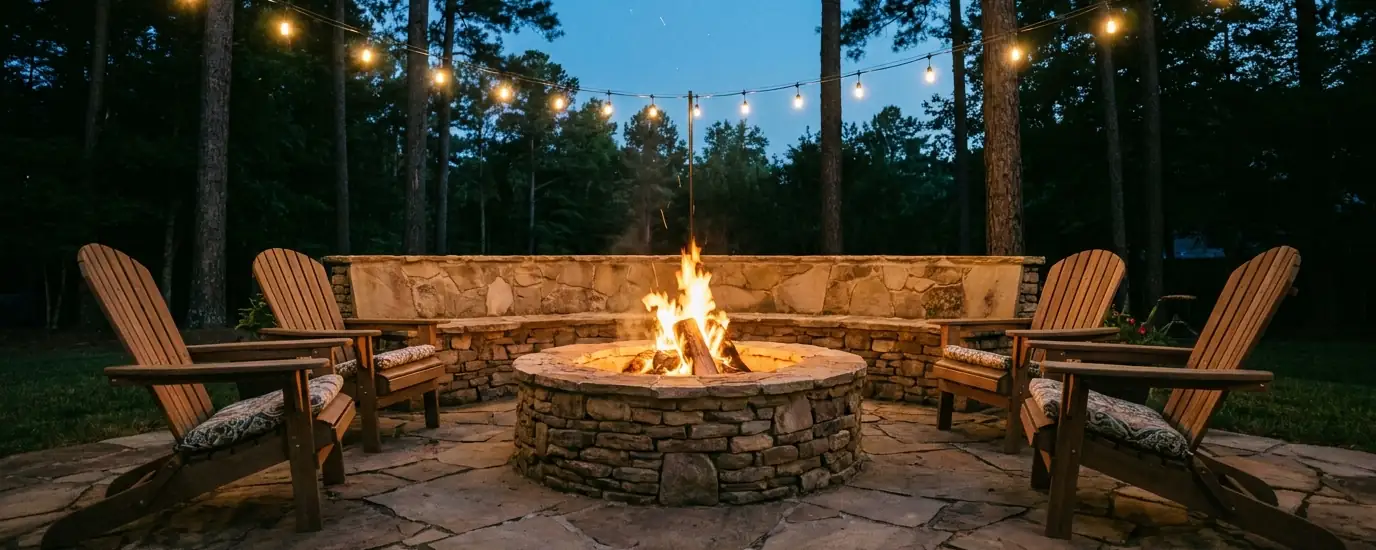
A fire pit puts everyone in a circle. Nobody has a bad seat, conversation runs across the middle, and kids can roast things. It is the more sociable of the two and the cheaper by a wide margin. It also throws heat in every direction, which means it warms fewer people harder.
Smokeless fire pits take the main complaint out of a wood fire. A double-wall design draws air in through the base and burns off most of the smoke before it rises, so you get real flames without moving your chair
every few minutes. They suit smaller yards and homes with close neighbors.
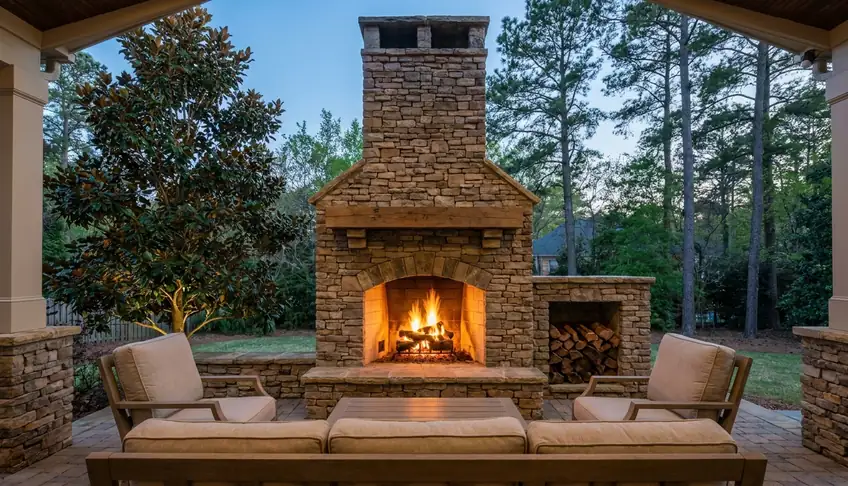
An outdoor fireplace faces one way. Seating lines up in front of it, the firebox pushes heat forward instead of upward, and the chimney takes smoke away from the people rather than into them. It reads as architecture: a wall, a focal point, something that anchors a patio. It costs several times what a pit does.
The practical test: if you picture six people talking, choose a pit. If you picture two people with a drink watching flames, choose a fireplace. If the yard gets wind off an open side, the fireplace wins on comfort every time.
What We Build
Custom masonry fire pits
Built in place from block and faced with stone, brick or veneer. Sized to the seating around them and sunk into the patio rather than perched on top.
Outdoor fireplaces
Full masonry structures with firebox, throat and chimney. The draw geometry matters more than the stone does, since a badly proportioned firebox smokes no matter how good it looks.
Gas fire features
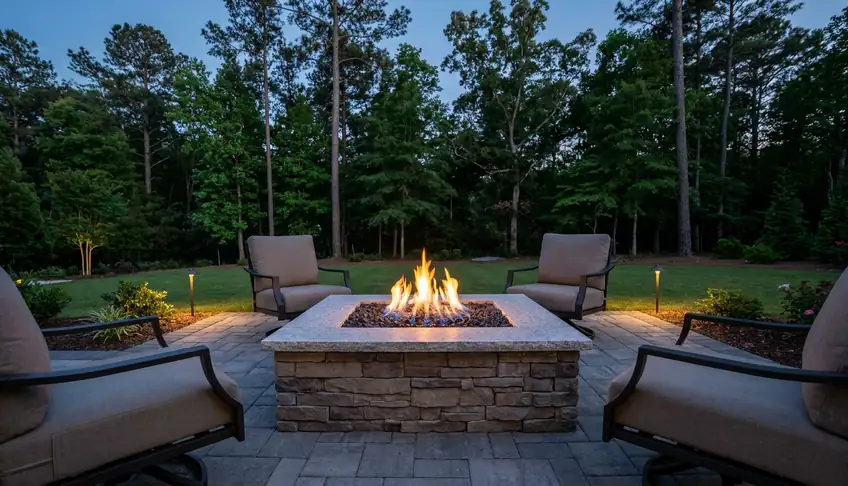
Natural gas or propane, with a burner, key valve or ignition, and lava rock or fire glass. Instant on, no smoke, no wood to store, and no ash to shovel on a Sunday morning
Wood-burning pits and fireplaces
For the real crackle and smell of a wood fire. Each one is built with a firebrick lining, drainage in the base and proper clearances. We also build smokeless fire pits, which burn off most of the smoke before it rises, a good choice for smaller yards.
Fire tables and linear features
Longer, lower gas features that double as a table surface. Popular alongside pools and on smaller patios where a full pit would eat the space.
Seating walls around the fire
Low walls that ring a pit and replace furniture. Cheaper than chairs, they never blow over, and they get built as part of the same hardscape.
Gas or Wood?
The single decision that changes the cost, the permitting and how often you actually use it.
Gas
On in seconds, off in seconds, and that convenience is why gas features get used more than wood ones.No smoke, so it suits covered patios and tighter spaces. It costs more upfront because of the line, the
burner and the permit. The gas line goes in through licensed trades we have worked with for years, with the scheduling handled on our end
Wood
Cheaper to build, and it does the thing gas cannot: smell, crackle, real radiant heat. Costs you a wood pile, ash disposal, and a longer wind-down before you can go inside. Smoke also matters more than people expect on a small lot with close neighbors.
Converting later
If gas is not in the budget now, the line can sometimes be sleeved during construction and connected
later. Far cheaper than cutting into a finished patio in two years. Worth deciding at the design stage.
Clearances, Drainage and the Parts Nobody Photographs
Three things decide whether a fire feature is safe and usable. None of them are visible.
Clearance to everything else
Distance from the house, the fence, the deck, low branches and anything with a fabric awning over it. Wood-burning features need considerably more room than gas. This is also the first thing an insurer asks about after an incident.
Drainage in the base
A masonry pit sitting on Georgia clay fills with water and holds it. Then the base cracks through a freeze,
and the first fire of the season steams instead of burning. Gravel base, a drain outlet, and a cover for the
wet months.
Firebrick and heat-rated materials
The inside of a firebox is not the outside. Standard block spalls and cracks under repeated heat cycles. Firebrick and refractory mortar cost more and are the reason a firebox lasts twenty years instead of four.
Draw on a fireplace
Firebox depth, throat size and chimney height have proportions that make smoke go up instead of out. Get them wrong and the fireplace smokes every time you light it. This is where masonry experience shows.
What a Fire Pit or Fireplace Costs in Atlanta
Fire features cover a wide range, from a simple masonry pit to a full fireplace with a chimney. The cost follows the type of feature, the materials and the level of finish.
Fire pit or fireplace
A masonry fire pit is the more affordable option. A full outdoor fireplace involves far more masonry, a footing, a chimney and often a permit.
Wood, smokeless or gas
Gas adds a burner, a line and licensed installation, and the cost grows with how far the line has to run.
Materials
Veneer, natural stone, brick or modular block on the outside.
What is built with it
Seating walls, a hearth, storage, and whether a new patio and footing go in at the
same time.
We give you a price once we have seen where the feature will go, how the ground drains and, for gas, how far the line has to run.
Permits and What Your HOA Will Ask
An open masonry fire pit usually does not need a permit. Running a new gas line generally does, and it needs a licensed installer.
A full outdoor fireplace with a chimney is often treated as a structure and permitted accordingly, particularly if it is attached to the house or sits under a covered area.
Most metro Atlanta subdivisions also want architectural review before anything permanent goes into a backyard. There are also seasonal outdoor burning restrictions in Georgia that apply to open wood fires, worth knowing before you build a wood pit rather than after. We look into both and handle the paperwork.
Our Work
See Our Fire Pit & Fireplace Projects
Fire features we’ve built for patios across Metro Atlanta.