Shade You Can Actually Use in a Georgia Summer
An open-slat pergola is a beautiful thing and it will not save you from a July afternoon in Atlanta.
Traditional pergolas, with posts, beams and spaced rafters, throw partial shade. Around forty to sixty percent depending on how tight the slats run and where the sun sits. That is pleasant in spring and October. In full July sun at two in the afternoon, with our humidity, it is not enough on its own.
So the starting question is this: do you want a structure that frames the space and grows vines, or one you will sit under in August while it is raining? Those are different builds and different budgets, and most
people work that out after the quote rather than before.
We would rather sort it out at the site visit.
What We Build
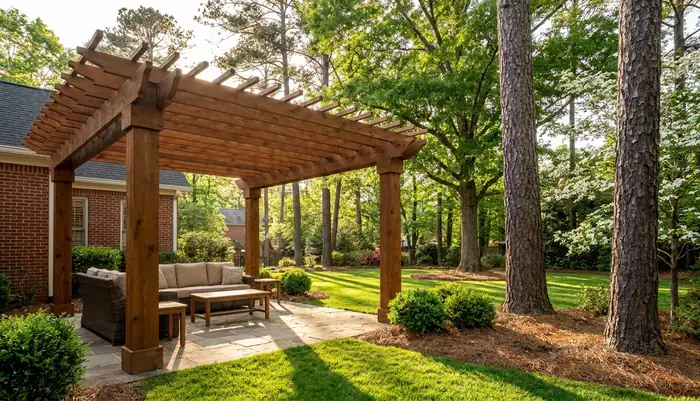
Traditional open pergolas
Posts, beams and rafters, in cedar or pressure-treated pine. The classic. Filtered shade, an anchor for climbing plants, and the most affordable structure on this page by a distance.
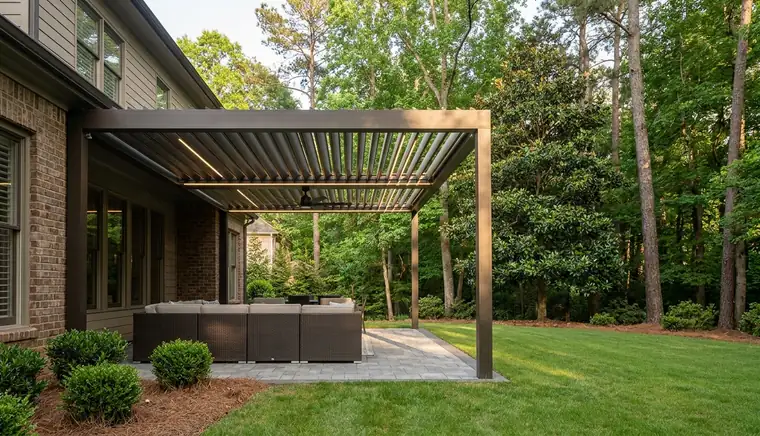
Louvered pergolas
Adjustable slats you rotate for more or less sun, and close entirely when a storm rolls through. Twenty
minutes later you open them again. Aluminum framed, motorized or manual, and the single best answer to
Atlanta’s weather if the budget reaches.
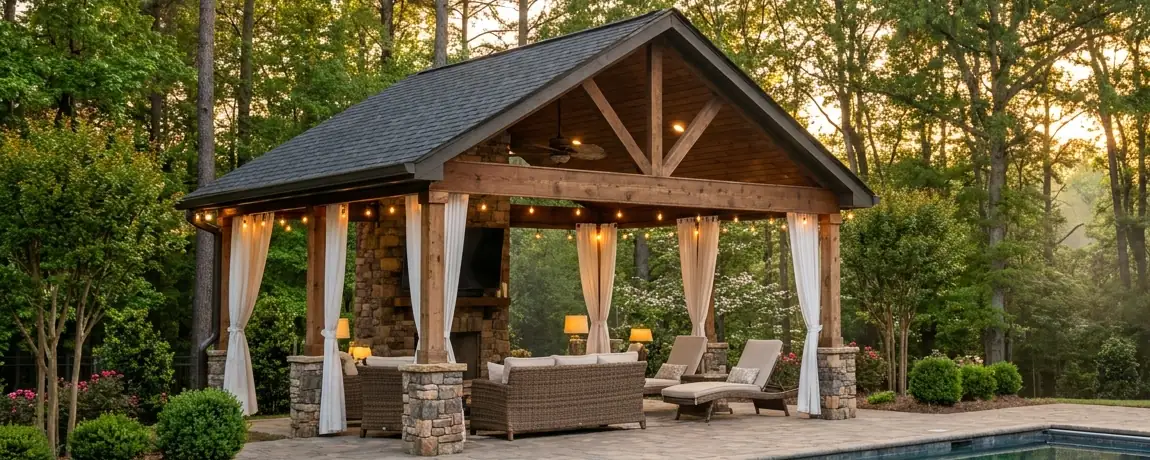
Solid-roof pergolas and pavilions
A real roof in shingle, metal or polycarbonate. Full rain protection, full shade, and what you want if a TV, an outdoor kitchen or upholstered furniture is going underneath.
Cabanas
Enclosed or part-enclosed structures, usually poolside. Changing space, storage, sometimes a bathroom or an outdoor shower. More building than furniture, and permitting usually applies.
Attached pergolas and shade over patios
Fixed to the house over a back door, a patio or a deck. Cheaper than freestanding since the house carries one side, but the attachment detail matters. Done badly it becomes a water intrusion problem in the wall.
Arbors and garden structures
Smaller entry arbors, gateways and covered walkways. Often the finishing touch on a landscape design rather than a project on their own.
Wood, Aluminum or Vinyl
Each fails differently in Georgia’s humidity. Worth knowing which trade-off you are buying.
Cedar
Resists rot and insects on its own, holds stain well, and has the grain people want from real timber. Re-seal it every two to three years here or it fades to gray. Mid to high on cost.
Pressure-treated pine
A popular choice with homeowners, and a solid one on a budget. It needs time to dry before staining and moves a little more than cedar as it settles. Seal it every few years, or let it weather to a natural gray.
Aluminum
No rot, no insects, no repainting, and it is what almost all louvered systems are built from. Powder-coated
finishes hold up well in our humidity. Higher upfront, close to zero maintenance, and it reads as metal
rather than wood, which suits some houses and not others.
Vinyl and composite
Low maintenance, consistent finish, and it can look flat under close inspection. Spans are more limited than aluminum, so large structures need more posts.
Built to Handle Atlanta Storms
A pergola catches more wind than most people expect. A 12 by 16 structure has a large surface area, and metro Atlanta’s summer storms bring gusts strong enough to test it. That is why the footings matter as much as the wood above them
Footings
Concrete piers sized to the structure and the soil. In our clay, footings that are too shallow move with the wet-dry cycle and the posts go out of plumb.
Post anchoring
Galvanized or stainless brackets holding the post above the concrete rather than sitting in it. Wood set directly into concrete wicks water and rots from the bottom, which is why so many older pergolas fail at
ground level first.
On an existing patio or deck
Doable, with a caveat. On a patio we usually cut through and pour proper footings beneath. On a deck the posts have to anchor into the framing, not the deck boards, and the deck itself has to be capable of taking the load. We will say plainly if it is not.
Attaching to the house
Correct flashing and a ledger fixed into structure, not siding. Get this wrong and the failure shows up inside the wall two years later.
What a Pergola Costs in Atlanta
A basic open frame and a motorized louvered system are both called pergolas, but they are priced very differently.
Size
The footprint, and how far the beams have to span between posts.
Material
Pine is the entry point, cedar a step up, with aluminum and composite at the top end.
Roof type
Open slats cost the least. A solid roof or an adjustable louvered system costs more, and with louvers the mechanism is a large part of the price.
Footings and placement
New footings, cutting into an existing patio, or building on a deck all add structural work.
Extras
Lighting, fans, heaters, privacy screens and retractable shades.
Once we know the size, material and roof you want, we put together a written quote with each option on its own line.
Do You Need a Permit for a Pergola in Atlanta?
A freestanding, open pergola under a certain size is usually exempt. One attached to the house, with a solid roof or electrical work, often does.
Cabanas are different. An enclosed structure with power, water or a bathroom is permitted like a building.
Many metro Atlanta subdivisions also require architectural review. We confirm both the permit and HOA rules for your address before quoting and file what is needed, so nothing has to be changed later.
Our Work
See Our Pergola & Cabana Projects
Shade structures we’ve built for backyards across Metro Atlanta.
Pergola & Cabana Questions